
Recently, a five-year-old Labrador lost his life while in the care of a local pet-care facility. Somewhere in the chain of events, either the right safety procedures were not in place or those procedures were not followed.
This article is not about criticizing another company. It is about recognizing the devastating consequences that can occur when professional pet care is left to assumption, improvisation, or chance.
Nobody should have to receive the call that their beloved furkid has been seriously injured, has escaped, or will never be coming home. Yet a simple Google search for “lost dog pet sitter” reveals story after story of preventable tragedies. Behind every headline is a real animal who paid the price and a family who must live with the loss.
It is heartbreaking. It is also why Always With Love Pet Care has invested so much time, care, and money into developing detailed standard operating procedures for our team.
Because loving animals is essential—but love alone is not a safety system.
What Are Standard Operating Procedures?
Standard operating procedures, commonly called SOPs, are written instructions that explain how specific responsibilities and situations must be handled. They establish a consistent standard so that safety does not depend on which sitter arrives at your home, what that person remembers in the moment, or how they personally believe something should be done.
In professional pet care, seemingly small decisions can have enormous consequences. How far should the front door be opened before checking for a pet? Should a backyard gate be checked even if the client says it is always secure? What happens if a harness looks worn? When does a change in a pet’s behavior require a message to the pawrent, and when does it require immediate escalation?
Our sitters should never have to invent those answers while standing in a client’s home. We make those decisions ahead of time, document them, teach them, and reinforce them.
Safety Begins Before the Visit Does
Professional care is not simply showing up, completing a list of tasks, and sending a cute picture. Safe care requires awareness from the moment a sitter approaches the home until the moment the visit is complete.
For example, our procedures address how to enter a home safely. A sitter does not simply unlock the door and swing it open. The door is initially opened only three to four inches—just enough to look inside, identify where the pets are, and confirm that the path is clear before entering fully.
That brief pause can prevent a dog or cat from slipping through the doorway.
It may sound like a tiny detail. But safety is often found in the tiny details.
Our procedures also require sitters to physically locate the pets expected to be in the home. We do not assume a cat is hiding in a favorite spot or that a dog is somewhere upstairs. We confirm that the furkids in our care are present and assess how they appear.
Equipment Is Checked Before Every Walk
A leash worked yesterday. A collar usually fits. A harness has never opened unexpectedly.
“Usually” is not a sufficient safety standard.
Before leaving the home, our sitters check the fit and condition of the equipment being used. That includes looking for:
- Fraying, cuts, or weakened areas in a leash
- Loose stitching or damaged material on a harness
- Cracks or weakness in plastic buckles
- Clips that do not close securely
- Collars or harnesses that are too loose or could be backed out of
- Changes in fit caused by weight loss, growth, grooming, or coat changes
We also pay attention during the walk. Equipment can shift, clips can catch on objects, and a frightened or excited dog may move differently than expected. Our responsibility is not merely to attach the leash. It is to continually protect the connection between the sitter and the dog.
A Walk Is Also a Wellness Check
Taking a dog outside and recording whether they peed or pooped is only one small part of a professional visit.
Our sitters are trained to observe the whole dog. We look for changes in:
- Gait, balance, or mobility
- Energy level and willingness to walk
- Breathing or tolerance for activity
- Appetite and thirst
- Urination and bowel movements
- Stool consistency, color, or unusual contents
- Behavior, comfort, and responsiveness
Loose stool may be more than an inconvenience. An unusual object in the stool could suggest that a dog ate something they should not have. A normally enthusiastic dog who suddenly refuses to walk may be experiencing pain or illness. A slight change in gait may be the first visible indication of an injury.
Furkids cannot tell us in words that something feels different. Caregivers must know how to notice—and what to do next.
We Never Assume a Backyard Is Secure
A fenced yard can create a false sense of safety. Gates may be left open by landscapers, delivery drivers, utility workers, family members, or neighbors. A latch can break. A section of fencing can become loose. A dog may discover a new place to dig or squeeze through.
That is why our procedures include checking gates and the condition of the yard before allowing a dog outside. Our sitters remain attentive during backyard let-outs rather than treating the yard as an opportunity to disengage from the pet.
We do not rely on what was true yesterday. We evaluate what is true today.
Clear Procedures Matter Most When Something Is Wrong
Routine visits are important. Unexpected situations are where preparation becomes critical.
Our SOPs address what a sitter should do when:
- A key or entry code does not work
- A pet cannot be located
- A gate, door, fence, leash, collar, or harness appears unsafe
- A pet refuses food or medication
- Vomit, blood, diarrhea, or another medical concern is discovered
- A pet’s behavior, breathing, mobility, or energy changes
- An unfamiliar or off-leash dog approaches during a walk
- Someone unexpected is inside or around the home
- The home shows signs of a leak, temperature problem, broken window, or another concern
- A sitter is delayed, becomes ill, or cannot complete assigned care
We have an established escalation process so sitters know what must be reported, how quickly it must be reported, and who needs to be involved. The sitter is not left wondering whether a situation is serious enough to mention. When in doubt, we would rather pause, communicate, and protect the furkid.
Procedures Protect the Client’s Home, Too
Our responsibility extends beyond feeding, walking, and loving the pets in our care. When clients are away, we may be among the only people regularly entering and observing their homes.
Our pet-sitting procedures include watching for packages, mail, water leaks, broken windows, unusual temperatures, doors that are not secure, and other signs of trouble. They also establish expectations for respecting the client’s property and privacy—including professional boundaries such as not using a client’s bathroom.
Trust is not limited to how we treat a pet. It includes how we conduct ourselves in someone else’s home.
A Written Manual Is Not Enough
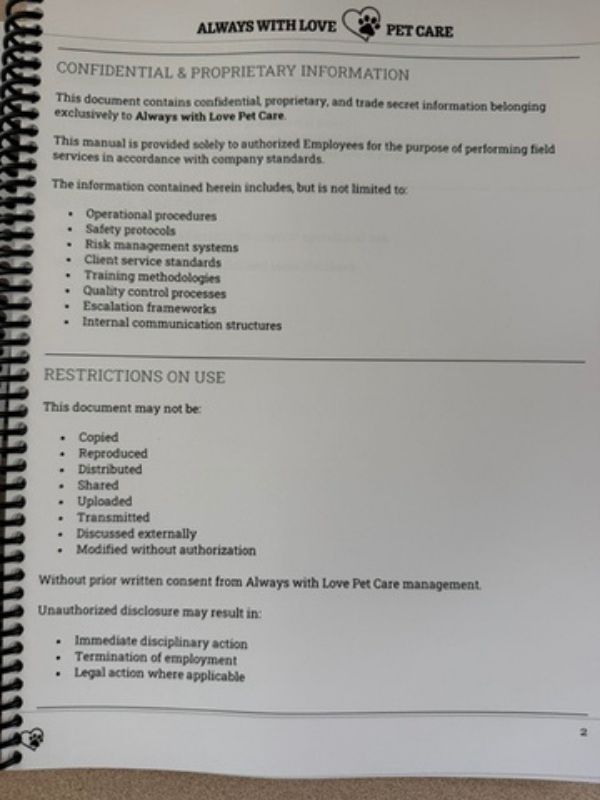
Any company can create a binder and place it on a shelf. The existence of a document does not make pets safer.
Our training process is built around our standard operating procedures. Sitters learn not only what the standards are, but why they exist. They work through realistic situations, answer questions that check their understanding, and learn when they are expected to stop and ask for guidance.
Our review and oversight processes are also designed to reinforce those standards. Visit journals, GPS records, sitter communication, follow-up, and leadership review help us verify that care is being provided consistently.
Accountability matters. If a procedure is not followed, it must be addressed. If a situation reveals a gap in our procedures, we examine it and strengthen the system. Our SOPs are living standards that continue to evolve as we learn, encounter new circumstances, and identify better ways to protect the pets entrusted to us.
Accidents and Preventable Incidents Are Not the Same
No pet-care provider can honestly promise that nothing unexpected will ever happen. Animals are living beings with their own instincts, behaviors, health conditions, and reactions. Even excellent caregivers can face emergencies.
But there is an important difference between an unavoidable accident and a preventable incident.
When something goes wrong, the questions should be:
- Was the risk reasonably anticipated?
- Was there a written safety procedure?
- Was the caregiver properly trained?
- Was the procedure followed?
- Was the situation escalated immediately?
- Was the family told promptly and honestly?
- Was the incident reviewed so the system could improve?
Professionalism does not mean claiming perfection. It means preparation, consistency, accountability, sound judgment, and transparency—especially when circumstances do not go as planned.
Questions Every Pawrent Should Ask
Before entrusting a pet-care provider with your furkids, ask more than whether the caregiver loves animals. Ask:
- Do you have written safety procedures?
- How are your caregivers trained on them?
- How do you confirm those procedures are being followed?
- What happens if equipment appears damaged or a gate is unsecured?
- What situations require immediate escalation?
- Who provides backup if the scheduled caregiver becomes unavailable?
- How and when will I be contacted if something goes wrong?
- Do you review incidents and update your procedures afterward?
A professional provider should be able to answer those questions clearly.
The Decisions We Make Before an Emergency
Standard operating procedures are not unnecessary paperwork. They are the decisions we make before an emergency happens.
They give our sitters a clear course of action when a door does not latch, a gate has been left open, a leash looks damaged, a dog begins walking differently, a cat cannot be found, or something simply does not feel right. In those moments, your furkid should not have to depend on someone guessing what to do.
At Always With Love Pet Care, every procedure we create and every standard we reinforce must support our North Star:
Increase a pet’s safety. Strengthen a client’s trust. Reinforce our standard of care.
In most cases, it does all three.
That is what Raising the Standard in Professional Pet Care looks like—not only in the promises we make, but in the steps we follow inside every home, during every walk, and at every visit.
