
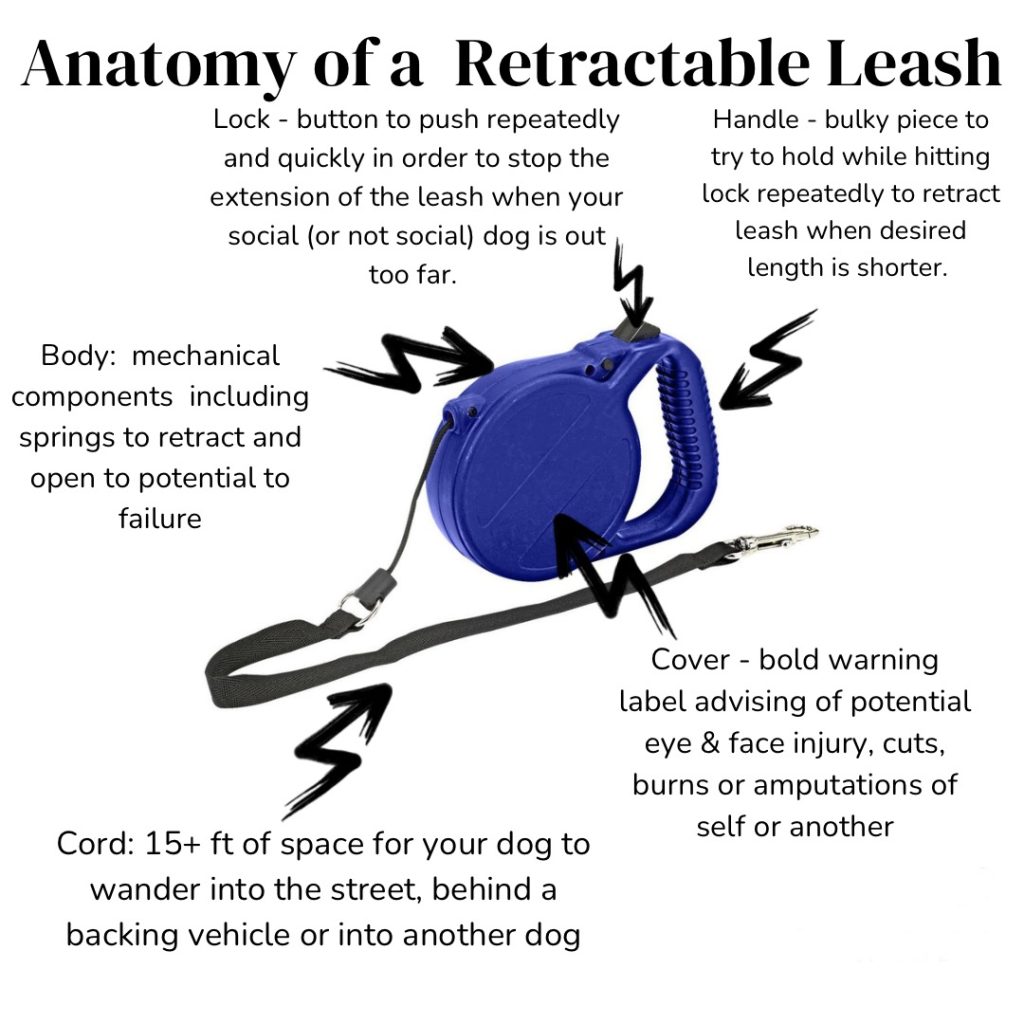
“I’ve used one for years and never had a problem.”
That’s probably the most common thing I hear when the topic of retractable leashes comes up.
And honestly? I understand why people buy them.
On the surface, they seem like the perfect solution. They give your dog more freedom to sniff and explore. You don’t have extra leash dragging on the ground. The leash automatically retracts, so it feels neat and convenient.
I get the appeal.
In fact, I bought one myself.
But after more than 18 years and tens of thousands of professional dog walks, I’ve yet to see a situation where a retractable leash was the safer choice. I have, however, seen plenty of situations where it made a dangerous one even harder to control.
The reality is this:
Dogs rarely get hurt during the normal part of a walk. They get hurt during the two seconds when something unexpected happens.
And those two seconds are exactly where retractable leashes fall short.
Retractable Leashes Don’t Really Solve the Problem
One of the biggest reasons people choose a retractable leash is because their dog walks faster than they do.
“I want him to have room to explore.”
I couldn’t agree more.
Dogs should sniff. They should investigate. They should enjoy their walks because sniffing is mentally enriching and one of the best parts of being a dog.
But here’s what actually happens.
Your dog reaches the end of the retractable leash.
Now they’re not walking any faster than you.
They’re simply 15 to 30 feet farther away from the person who’s supposed to protect them.
If they suddenly:
- Chase a squirrel…
- Step toward traffic…
- Head behind a backing vehicle…
- Encounter another dog…
- Have a cyclist or e-bike appear behind them…
- Or an off-leash dog comes charging over…
…you’re trying to solve that problem from 15 or 20 feet away instead of right beside them.
That distance matters.
Emergencies Don’t Schedule Themselves
Dogs don’t wait until you’ve wrapped up the leash.
They don’t wait until you’ve found the lock button.
They don’t wait until you have both hands free.
The squirrel appears.
The garage door opens.
A child suddenly runs toward your dog wanting to pet them.
A delivery driver rounds the corner.
A bike silently comes up from behind.
An off-leash dog rushes over.
The emergency happens first.
We react second.
The equipment we choose determines how quickly we can react.
Retracting Isn’t Nearly as Easy as People Think
One thing I hear often is,
“I’ll just lock the leash.”
Unfortunately, it’s rarely that simple.
When your dog is pulling against the end of the leash, shortening it requires multiple coordinated actions.
You’re pressing the lock button.
You’re using your wrist to reel the leash back in.
You’re maintaining tension.
You’re trying to keep walking.
And you’re hoping the mechanism responds exactly as intended.
That’s asking a lot during an emergency.
With a standard leash?
You simply slide your hand down the leash or double it up.
One motion.
No buttons.
No springs.
No delay.
“But My Dog Likes to Sniff”
Mine do too.
The good news is you don’t need a retractable leash to give your dog freedom.
An 8-10 foot leash gives most dogs plenty of room to sniff while still allowing you to quickly regain control if something unexpected happens.
If you’re hiking, camping or exploring a large open field, a properly supervised 15-30 foot training line is a wonderful option.
The difference is that you’re managing a leash—not relying on a mechanical device to manage it for you.
The Convenience Isn’t What You Think
People also tell me they don’t like dealing with extra leash dragging on the ground.
That’s fair.
But there are simple solutions.
Tie a knot in the leash.
Choose a leash with an extra traffic handle closer to your dog.
Wrap the extra length in your hand.
Personally?
I’ve always found the bulky plastic handle of a retractable leash more awkward to carry than a simple nylon leash.
Sometimes it’s just a small change in how we think about the problem.
And that small change can make a huge difference in safety.
The Only Leash With Amputation Warnings
This is something many people never think about.
Retractable leashes are the only type of leash routinely sold with warnings about:
- Eye injuries
- Facial injuries
- Rope burns
- Severe cuts
- Finger amputations
- Injuries to other people
That isn’t because manufacturers are overly cautious.
It’s because the thin cord and tightly wound spring system create hazards that simply don’t exist with a traditional leash.
If that cord wraps around fingers…
Ankles…
Legs…
Or even another dog’s legs…
Serious injuries can happen in a split second.
Tiny humans are especially vulnerable because they’re often right at leash level.
The Walk That Changed My Mind
I wasn’t always anti-retractable leash.
In fact, I bought one for our very first dog, Wishbone, back in 2004.
Like most people, I thought it seemed like a great idea. More freedom for her. Less leash for me to manage.
We took her to Busse Woods and walked out into the open fields away from the main paths so she could run and explore.
She was having the time of her life.
Then she turned and came running back toward me.
Before I even realized what had happened, the thin retractable cord whipped across the back of my leg and sliced it wide open directly over my Achilles tendon.
It happened in an instant.
One second we were simply enjoying a beautiful walk.
The next, I was bleeding because of a piece of equipment I had trusted.
Thankfully, it was my leg and not a child’s face, someone’s fingers, another dog’s legs, or Wishbone herself.
That experience completely changed how I looked at retractable leashes.
It wasn’t because Wishbone did anything wrong.
She was simply being a happy dog.
The leash did exactly what retractable leashes are designed to do.
And in the wrong circumstances, that’s all it takes for someone to get hurt.
Mechanical Things Eventually Fail
A standard leash is incredibly simple.
Webbing.
A clasp.
A handle.
There’s very little to fail.
Retractable leashes contain springs, gears, locks, cords and moving mechanical parts.
Over the years I’ve seen lock buttons stop working.
I’ve seen cords snap.
I’ve seen housings crack after being dropped.
I’ve seen the internal spring stop retracting altogether.
Every one of those failures happened at exactly the wrong time.
Two Dogs Make It Even Harder
I’ve also seen retractable leashes marketed for walking two dogs at once.
Personally, I think that’s adding complexity where simplicity is much safer.
Even dogs that adore one another naturally weave back and forth.
Those thin cords wrap around legs.
Around people.
Around trees.
Now you’re trying to untangle everyone while both dogs are still under tension.
If either dog becomes uncomfortable…
Or startled…
Or frustrated…
What started as a tangle can quickly become a fight.
Sometimes the Leash Becomes the Problem
Here’s another situation I’ve seen more than once.
A dog makes a quick movement that the person simply isn’t expecting.
The bulky plastic retractable handle slips out of their hand and hits the ground.
Now that hard plastic handle is clanking and bouncing behind the dog.
Most dogs don’t stop and think, “Oh, that’s just my leash.”
They panic.
The faster they run, the louder that handle bounces behind them.
The louder it gets, the more frightened they become.
Now your dog isn’t just running…
They’re running in full flight mode with something “chasing” them.
It’s a terrifying cycle that can happen in seconds and one that’s incredibly difficult to stop.
With a traditional leash, if you accidentally drop it, there’s no heavy plastic handle crashing along behind your dog, adding fear to an already stressful situation.
Small Dogs Aren’t Safer
People often assume retractable leashes are fine because their dog only weighs ten pounds.
But if an off-leash dog approaches…
A coyote appears…
Or your little dog panics…
It’s actually harder to quickly scoop them into your arms when they’re twenty feet away.
Large Dogs Present a Different Problem
Large dogs place tremendous force on every moving part inside a retractable leash.
Even if nothing breaks, trying to pull an eighty-pound dog back using a thin cord is much harder than controlling them with a sturdy six-foot leash close to your body.
I’ve Seen It With Seniors Too
I’ve watched seniors use retractable leashes because they seemed easier while using a walker or simply stepping out the back door.
Then the dog spotted a squirrel.
Or wrapped around a bush.
Or suddenly lunged.
Instead of making the walk easier, the leash made it much harder to regain control.
The result can be a serious fall.
What About Local Leash Laws?
There’s another point many people don’t realize.
Most of the communities we proudly serve—including Schaumburg, Hoffman Estates, Rolling Meadows, Arlington Heights, Palatine, Elk Grove Village and several surrounding suburbs—have leash ordinances that generally limit dogs to leashes of approximately six to eight feet in public.
Once a retractable leash extends beyond that, it may no longer comply with local leash laws.
Is There Ever a Safe Way to Use One?
People ask me this all the time.
My answer is still no.
Not because every retractable leash fails.
Not because every walk ends badly.
Retractable leashes probably work just fine on hundreds of walks.
The problem is we don’t buy safety equipment for the easy walks.
We buy it for the one walk where something goes wrong.
People sometimes assume I dislike retractable leashes because I’m old-fashioned or because “that’s just how professional dog walkers do it.”
The truth is much simpler.
I’ve owned one.
I’ve been injured by one.
And after walking dogs professionally for more than 18 years, I’ve never seen a situation where I thought,
“I wish this dog had been on a retractable leash.”
I’ve thought the opposite many, many times.
One Small Change That Makes a Big Difference
At the end of the day, this isn’t really about leashes.
It’s about giving yourself the very best chance to protect your best friend when something unexpected happens.
If your dog loves to sniff, give them a little more leash.
If they need room to explore, use a longer training line in an appropriate open area.
Choose the straight leash length that best fits your dog’s lifestyle.
But when you’re walking through neighborhoods, crossing streets, passing children, bikes, wildlife and other dogs…
Simplicity wins.
It’s one small change in equipment.
But it can make a very big difference in safety—for your dog, for you and for everyone around you.
After more than 18 years of walking dogs professionally, I’ll choose a simple straight leash every single time.
Not because it’s trendy.
Not because it’s what we’ve always done.
Because when my job is protecting someone’s beloved family member, I want the simplest, quickest and most reliable tool in my hand.
And if sharing my own mistake keeps even one dog—or one person—from getting hurt, then Wishbone’s walk back in 2004 still has something valuable to teach us today. 💜
