
When we talk about walking dogs, we tend to focus on exercise.
Did they get enough steps? Did we go far enough? Did we tire them out?
But a great dog walk isn’t just about how much physical energy your dog burns.
It’s about their brain, too.
The Walk Isn’t Just About Walking
Have you ever wondered why your dog needs to stop and sniff every tree, mailbox, lamppost and suspicious-looking blade of grass?
They’re gathering information.
Sniffing is one of the primary ways dogs understand what’s happening in the world around them. Who has been here? Was it another dog? How recently? What’s changed since yesterday?
That tree you’ve walked past 400 times?
Your dog hasn’t finished reading it yet.
Allowing your dog time to sniff, explore and investigate provides mental stimulation in addition to the physical exercise they’re getting from the walk. And mental work can be incredibly tiring.
That’s why our goal isn’t necessarily to cover the greatest distance possible.
A shorter walk filled with sniffing, exploring and engagement can sometimes do more for a dog than power-walking a mile while constantly pulling them away from everything they want to investigate.
Give them some freedom within the boundaries of the leash. Let them wander from one side of you to the other when it’s safe. Let them investigate the tree. Let them spend an extra 20 seconds figuring out exactly what happened to that mailbox.
The walk is their outing, too.
But giving your dog freedom to explore doesn’t mean giving up control.
That’s where good equipment—and good leash handling—become incredibly important.
Start With the Right Leash
For everyday neighborhood walks, we’re big fans of a simple fixed-length leash.
Four to six feet is usually a great length for maintaining control while still giving your dog room to explore. Longer fixed leashes may also work in appropriate areas, but always check your local leash ordinances. Many municipalities limit leash length in public spaces.
What matters most is that you can quickly control how much distance exists between you and your dog.
Because walks are unpredictable.
A rabbit can dart across the sidewalk.
A squirrel can suddenly become the most important thing your dog has ever seen.
A child can come flying around the corner on a bicycle.
A motorcycle can roar past.
Or you may encounter one of our least favorite surprises:
“Don’t worry! He’s friendly!”
…as an off-leash dog comes running toward you.
Your dog’s safety in those moments depends heavily on your ability to respond quickly.
A four- or six-foot fixed leash gives you that control while still allowing plenty of freedom for sniffing and exploring.
A retractable leash—or a 20- or 30-foot long line used on a neighborhood sidewalk—doesn’t provide that same immediate control.
Long lines absolutely have their place. They’re wonderful tools for open spaces, training and controlled exploration.
They just aren’t the right tool for every environment.
What Are You Connecting That Leash To?
The leash is only half of the equation.
At the other end, you’ve got your dog’s collar or harness—and choosing between the two often comes down to your preference, your dog’s comfort, their body structure and how they behave on a leash.
We’re not going to dive into the great harness debate today.
Front clip. Back clip. No-pull. Y-shaped. Step-in.
There are a LOT of options, and each has its own advantages and disadvantages. That’s a conversation for another day.
For now, let’s focus on the most important part:
Whatever you’re attaching that leash to needs to fit your dog properly and securely.
A Special Consideration for Our Squishy-Faced Friends
If you have a brachycephalic—or flat-faced—breed such as a French Bulldog, Boston Terrier, Pug or Shih Tzu, I’m a big fan of walking them on a properly fitted harness rather than attaching the leash to their collar.
These breeds are already anatomically predisposed to having more difficulty moving air efficiently than a dog with a more typical airway structure.
Adding pulling pressure around the neck isn’t something I want to add to that equation.
A properly fitted harness allows you to control your dog without concentrating that leash pressure around their neck and airway.
That doesn’t mean the harness should be loose, though.
Because a harness that your dog can escape from isn’t keeping anybody safe.
Remember the Two-Finger Rule
Whether you’re using a collar or harness, fit matters.
With a collar, you generally want enough room to comfortably slide two fingers underneath it.
You don’t want it so tight that it’s putting unnecessary pressure on your dog’s neck, but you also don’t want it hanging loosely enough that your dog can easily slip their head out.
And yes—dogs absolutely can back out of collars.
Usually at exactly the moment you really, really don’t want them to.
The same basic two-finger guideline can be helpful when checking a harness.
Your dog should be able to move comfortably without rubbing, pinching or restriction, but there shouldn’t be huge gaps between the harness and their body.
Here’s a simple test:
Look at your dog from different angles while they’re standing and moving.
Is the harness sitting against their body?
Or are you seeing big gaps opening around the chest as they move?
Can they twist inside of it?
Could they potentially get an elbow through somewhere?
Most importantly, ask yourself:
If my dog suddenly stopped, planted all four feet and started backing away from me, could they get out of this?
Because that’s frequently how dogs escape equipment.
They don’t necessarily pull forward until something breaks. Something frightens them, they hit the end of the leash, and then they throw their weight backward.
Suddenly that harness that seemed plenty tight enough is sliding over shoulders and a very frightened dog is loose.
Got a Little Houdini?
Some dogs seem to possess a special talent for backing out of absolutely everything we put on them.
For those pups, there are more escape-resistant harness designs available, including three-strap harnesses that add another point of security farther back on the dog’s body.
They can be especially helpful for nervous dogs, known escape artists or dogs whose body shape makes traditional harnesses easier to slip.
We’ll save the different harness styles—and when you might choose one over another—for another blog.
For today, the takeaway is simple:
The best leash in the world can’t protect your dog if what it’s attached to comes off.
Before you head out the door, take a few seconds to check the fit of your dog’s equipment.
Snug.
Comfortable.
Secure.
Now let’s talk about what you’re doing at the other end of that leash.
How You Hold the Leash Matters
Here’s one of the simplest leash-handling changes you can make.
Put your hand through the loop and then grip the neck of the leash.
Don’t simply hold onto the loop with your fingers.
Why?
Because dogs are fast.
One unexpected lunge toward a squirrel can create enough force to yank a loosely held leash straight out of your hand.
Putting your hand through the loop and gripping the leash gives you a much more secure connection to your dog without tying the leash around your hand.
And that’s an important distinction.
Never Wrap the Leash Around Your Hand
It can feel safer—especially when you’re walking a large or powerful dog.
“If I wrap this around my hand, there’s no way I’m dropping it.”
True.
Unfortunately, there’s also no easy way to get your hand out of it.
If a powerful dog suddenly lunges or takes off running, that leash can tighten around your fingers, hand or wrist with tremendous force. That can cause serious injuries, including crushed fingers, fractures and other hand or wrist injuries.
You want a secure grip.
You don’t want to physically tether the leash around your hand.
The Two-Knot Trick
This is one of my favorite simple leash-handling tricks, particularly when walking stronger dogs.
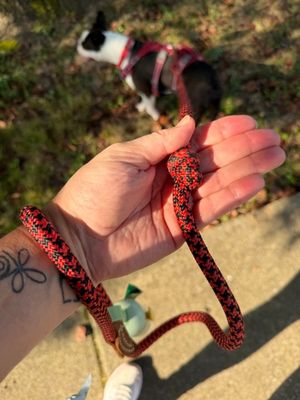
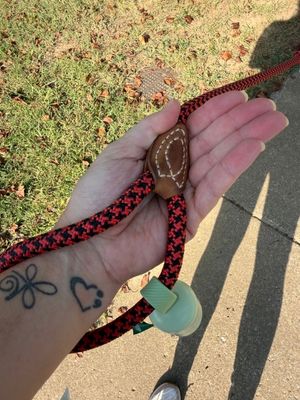
Take a standard straight leash and tie a couple of knots into it.
Place one roughly a foot or so below your hand.
Place another closer to your dog’s collar or harness.
Why?
Those knots become instant grab points.
If you’re approaching an intersection, you can slide your hand down and grab the first knot to shorten the leash.
If another dog approaches and you need your dog immediately beside you, you have another secure point closer to your dog.
The knots give your hand something to grip instead of trying to hold onto a smooth piece of nylon while your dog is pulling in the opposite direction.
Some leashes already have a second traffic handle built into them, and we LOVE those.
But if yours doesn’t?
A couple of strategically placed knots can accomplish something very similar without buying another leash.
This can be especially helpful when you’re walking through busier environments—a farmers market, a crowded sidewalk, a parking lot or anywhere else where you need your dog tucked safely beside you.
Sometimes the Safest Move Is Simply Creating Distance
Good leash handling isn’t about overpowering your dog.
It’s about anticipating situations before your dog feels like they need to react to them.
If you know your dog gets excited, nervous or reactive when another dog approaches, you don’t have to prove that they can walk past one three feet away.
Cross the street.
Turn around.
Walk up a driveway for a moment.
Step behind a parked car.
Use a tree, hedge or other visual barrier.
Creating distance isn’t failing at the walk.
Creating distance is handling the situation.
Every dog has a threshold. Once they’re over it—barking, lunging, spinning or completely focused on another dog—getting their attention back becomes much harder.
Whenever possible, respond before they reach that point.
Your job isn’t to make your dog tolerate every situation you encounter.
Your job is to notice what’s happening around you and help them safely navigate it.
Put Their Nose to Work
Here’s another incredibly simple tool:
Treats.
If something in the environment has your dog’s attention, scatter a few treats into the grass and encourage them to:
Find it!
Now their nose goes down.
Instead of staring at the dog across the street, they’re sniffing.
Instead of building excitement around the rabbit they just saw, they’re searching through blades of grass for tiny pieces of deliciousness.
You’re redirecting their brain toward another activity while simultaneously giving them additional mental enrichment.
And you don’t have to wait for a distraction to appear.
Turn it into part of the walk.
Scatter a few treats in the grass.
Hide one near a tree.
Ask for a simple behavior they know.
Change directions.
Let them sniff.
Talk to them.
Engage with the dog you’re walking.
A walk can be an opportunity for physical exercise, mental stimulation, training, confidence building and—perhaps most importantly—time spent engaging with you.
Good Leash Handling Isn’t About Keeping a Dog at Your Knee
There’s a time for having your dog close.
Crossing streets.
Passing people.
Walking through crowds.
Navigating parking lots.
Encountering another animal.
But when the environment is safe?
Give them a little room.
Let them sniff.
Let them explore.
Let them be a dog.
The goal isn’t to maintain six feet of perfectly straight leash while marching around the neighborhood.
The goal is knowing when your dog can safely have freedom and when you need to bring them close.
That’s what good leash handling really is:
Freedom when it’s appropriate.
Control when it’s necessary.
Awareness all the time.
Because a great dog walk isn’t measured only in miles.
It’s measured in how safely we navigate the world with the furkid at the other end of the leash—and how much we allow them to experience along the way.
The love may be the natural side effect. But safety is always intentional.
